Thursday, April 16, 2020

Beginning German Research

 The Salt Lake Institute of Genealogy offered a Library Day at the Family History Library in January 2020, with several free classes.  

From the class Beginning German Research by Fritz Juengling, I learned : 

  • The FamilySearch Community for German research is an invaluable place to pose your research questions
    • Ask for translation help or for help understanding the document 
    • Join the Polish community if your ancestors came from eastern states.
    • The Family History Library staff check in regularly to the Community and offer their advice.
    • Other regions/topics have community groups but they may not be as active.
  • The website Archion has many Protestant records (no Catholic records). View search results for free, but pay to view the images. The website is a work-in-progress. 
  • The website Matricula is primarily Catholic records (some Protestant). Their goal is to put all church records online. They have many Austrian and Luxembourg records and some for Germany. 
  • The online Meyer’s Gazette is a work-in-progress. 
    • The project began with northern Germany, some southern areas aren’t included yet. 
    • About ⅔ of Germany is on the website. 

JO

Thursday, March 26, 2020

Tips on FamilySearch.org


The Advanced Hispanic Research Workshop offered by the Salt Lake Institute of Genealogy (SLIG) included a class on using FamilySearch.org, especially in regards to Hispanic research: 
  •  If your ancestor came from a town with many churches, try searching the biggest cathedral’s records first. People wanted to have their baptisms/marriages/funerals at the big, impressive cathedral. 
  • The magnifying eyeglass icon means some, but not necessarily all, of the records on that roll are indexed. 
  • Keyword search is very important as many different catalogers over the years may have used different terms. If you do a search for record types, use English, such as census instead of censo. But with a keyword search, use Spanish, such as registros militares or Mexico padrones. 
  • To search for archive holdings, try a keyword search using the phrase “Archivo general de la nacion” + the name of the country, for example “archivo general de la nacion Mexico.” 
JO

Research in the Colonial Southwest

The Advanced Hispanic Research workshop offered at the Salt Lake Institute of Genealogy had a class on research in the Colonial Southwest, taught by Henrietta Martinez Christmas. Here are some tips: 
  •  All records were burned during the 1680 Pueblo Revolt; the previous century had to be recreated from other sources. 
  • Santa Fe was the only villa starting 1605. After 1692 two new villas - Santa Cruz and Albuquerque. 
  • Had to have permission to move up and down the Camino Real (royal road). Immigration was rare and was strictly monitored; sanctioned traveled was allowed on the Santa Fe trail and the Chihuahua trails. Merchant caravans were allowed with taxes and are not well documented. It was against the law to be a foreigner in Spanish land. 
  • For Santa Fe research, the New Mexico Genealogical Society website is better than FamilySearch.org, primarily because the records are better labeled.  On FamilySearch some records are under “Miscellaneous.” 
  • Best places for research: Albuquerque Public Library, 2nd floor; New Mexico State Records Center and Archives; University of New Mexico - Center for SW; Rocky Mountain online archive https://rmoa.unm.edu/; New Mexico State University in special collections 
  • You can find wills and probate in land grant records. 
  • Southern Colorado was part of New Mexico, their land grants are part of the New Mexico record group. Arizona land grants are in New Mexico. El Paso was part of New Mexico until 1821. 
JO

Tuesday, March 17, 2020

Western States Marriage Records Index

One of the special collections at Brigham Young University-Idaho (BYU-I) is an online marriage index of early Western marriages. It includes all continental western states, everything west of Montana, Wyoming, Colorado, and New Mexico. The ongoing project extracts early marriage records from counties in the western part of the United States.

The index is not comprehensive for the time period and localities described, but as of March 17, 2020, “this file contains over 913,341 marriage records with additional entries being added nearly every working day.”

Marriages date from as early as the 1700s for New Mexico, and into 1930s and even later.

http://abish.byui.edu/specialCollections/westernStates/search.cfm


JO

Tuesday, March 3, 2020

Hispanic Notarial Records


Notes from Salt Lake Institute of Genealogy course Advanced Hispanic Research, Salt Lake City, January 2020


·         A notario, or notary, functions much like a contract lawyer, creating legally binding “authentic acts” (also called contracts or protocols), that regulate private relationships among individuals.

·         Notarios represented both parties and used standard form books.

·         Spanish law (and hence Latin America), required a notary in every town, dating back to the 13th century.

·         Notarial documents of interest to genealogists include marriage contracts, death inventories/estate settlements, and property sales/transfers.

 ·         How to find records in the archive
o    Books are generally organized chronologically under under the notary’s name
o    you will need to know the name of the notary (find this in death records), the town in which he served, the years in which he served; generally, a family continued to use the same notary
o    with this info you can request the legajo

·         Possible locations of notarial records: 
o    provincial archives
o    district archives
o    municipal archives
o    ecclesiastical or government archives
o    if not at archives, try local notary colegio, especially if records are more recent
o    local libraries or notarial offices
o    Records under 25 years old may be with notary; records 25 to 100 years old may be at notarial college; records more than 100 years old may be at an archive

·         Women could own property in Spanish countries and had significant testamentary power. They often left specific bequests to female family members and friends.

·         Use these terms in a Keyword search for notarial records: protocolos, registros, notariales, notaria, testamentos


JO

Wednesday, February 12, 2020

Catholic Church Records

Notes from SLIG Advanced Hispanic Research, Salt Lake City, January 2020 on

Catholic Church Records

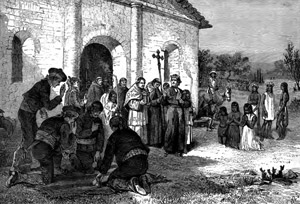
Illustration of the Alamo as a mission as imagined in 1883.

• Always note and investigate padrinos (godparents) in baptism records. They are usually family members. There is a godparent convention, but you can’t assume this was always followed; for example, the firstborn child would have maternal grandparents as godparents. 

• In Spain’s baptism records before 1750 you’re unlikely to find the grandparents’ names; they show up more in records from 1800s. In some Mexican states grandparents were included, but some states (such as the one I research!) did not record grandparents. 

• Also is Spain - mothers’ names were sometimes absent in baptism records. You may only see reference to the mother as mujer de, as in “woman of” the father of the child. 

• Don’t mistake a velacion (blessing ceremony) record for the marriage record. Velaciones records are sometimes accidentally indexed as a marriage record. Velaciones can occur at a much later date or even in a different town than the marriage. 

• Among impediments to marriage that would require a dispensation are consanguinity by marriage, consanguinidad por matrimonio, meaning the intended spouse is related to the deceased spouse;and previous vows of chastity, such as nuns, monks, priests. Gave example of a count dying and needing a male heir, so a dispensation  was requested so that the priest, as the next male heir, could be excused from priesthood to marry and have kids. 

• The marriage process: investigation, consent, reading of the banns (amonestaciones), the ceremony itself (a mass and the marriage), blessing (velacion) 

• Sometimes parish records get split up. For example, the town of Janos has parish records in three different towns. 

• An abandoned child may be referred to as niño exposito (exposed child), niño de la iglesia (child of the church), or niño de rueda (child of the wheel - referring to a rotating device within a church door used to anonymously abandon a baby at the church). 

• While in some countries - including the U.S. and Germany - bishops required all parish registers entries be made in Latin, in Spain and her former colonies the parish registers are written in Spanish.

•Jesuits played a central role in the growth of Catholicism in Mexico, but in the 1760s the Jesuits were driven out of Spanish territories. Franciscans came in, but lacked the robust funding and reach of the Jesuits. This affected how soon people received the sacraments.

JO

Tuesday, December 10, 2019

Staff Meeting Notes


Staff Meeting Notes
Tuesday, December 10, 2019

Attendees: SK, MH, SB, JO, RS, FS, Djuina Hammett

Team Building Activity (MH): Name the worst movie you’ve ever seen or a popular movie you’ve never seen

5-minute resource (FS): Mississippi Death Index
  • Digitized and available on Internet Archive
  • Covers years 1912-1943; for later dates must inquire with Mississippi vital records
  •  Codes are used for counties, race and gender
  • Clayton Library has Mississippi death index on microfilm and it is much more legible than the digitized version. No other institutions seem to hold this resource.

Section Reports:
  • SB – thanks to all for their help with volunteer party; volunteers had a good time. Great job Steven!
  • JO- regarding class registration for February 8th event – African American History Month with Sharon Gillins and Ari Wilkins at the Holocaust Museum Auditorium - please ask for customer’s name, phone number and email address so we can email them the handouts. It will be an all-day event with lots of talks and attendees. More details TBA.
  • FS and RS will attend 1619 Project training at UH. It is about developing a teaching module on slavery in the U.S.
  • FS – the roof is leaking again.
  • SK received the Lloyd DeWitt Bockstruck Distinguished Service Award on Saturday from the Dallas Genealogical Society. Congratulations Sue!


Renovation Update:
  • There is a delay on the new furniture. May arrive in mid to late February.
  • SK to meet with renovation coordinators to get more information.


Manager’s Meeting Overview:
  • Review Clayton Library blog entry on resources for homeless customers
  • Remember 211 is a resource as well. It is a free helpline operated by United Way, available 24 hours a day, 7 days a week in many languages
JO


Staff Meeting Notes

  Staff Meeting 20 DEC 2022 notes Agenda and notes can be found here: CLATeam>FY23>Agendas>Rolling Agenda