Notes from SLIG Advanced Hispanic Research, Salt Lake City, January 2020 on
Catholic Church Records
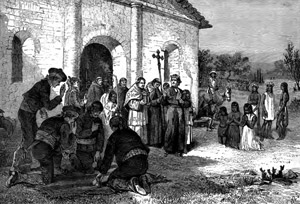
• Always note and investigate padrinos (godparents) in baptism records. They are usually family members. There is a godparent convention, but you can’t assume this was always followed; for example, the firstborn child would have maternal grandparents as godparents.
• In Spain’s baptism records before 1750 you’re unlikely to find the grandparents’ names; they show up more in records from 1800s. In some Mexican states grandparents were included, but some states (such as the one I research!) did not record grandparents.
• Also is Spain - mothers’ names were sometimes absent in baptism records. You may only see reference to the mother as mujer de, as in “woman of” the father of the child.
• Don’t mistake a velacion (blessing ceremony) record for the marriage record. Velaciones records are sometimes accidentally indexed as a marriage record. Velaciones can occur at a much later date or even in a different town than the marriage.
• Among impediments to marriage that would require a dispensation are consanguinity by marriage, consanguinidad por matrimonio, meaning the intended spouse is related to the deceased spouse;and previous vows of chastity, such as nuns, monks, priests. Gave example of a count dying and needing a male heir, so a dispensation was requested so that the priest, as the next male heir, could be excused from priesthood to marry and have kids.
• The marriage process: investigation, consent, reading of the banns (amonestaciones), the ceremony itself (a mass and the marriage), blessing (velacion)
• Sometimes parish records get split up. For example, the town of Janos has parish records in three different towns.
• An abandoned child may be referred to as niño exposito (exposed child), niño de la iglesia (child of the church), or niño de rueda (child of the wheel - referring to a rotating device within a church door used to anonymously abandon a baby at the church).
• While in some countries - including the U.S. and Germany - bishops required all parish registers entries be made in Latin, in Spain and her former colonies the parish registers are written in Spanish.
•Jesuits played a central role in the growth of Catholicism in Mexico, but in the 1760s the Jesuits were driven out of Spanish territories. Franciscans came in, but lacked the robust funding and reach of the Jesuits. This affected how soon people received the sacraments.
JO

For more information about "niño de rueda or child of the wheel" see the Wikipedia article Baby Hatch https://en.wikipedia.org/wiki/Baby_hatch or google "Foundling wheel." It was a medieval concept/invention that has been in use around the world up into the 20th century. Currently revived in many places with a "Baby Hatch." -- IBW
ReplyDelete